

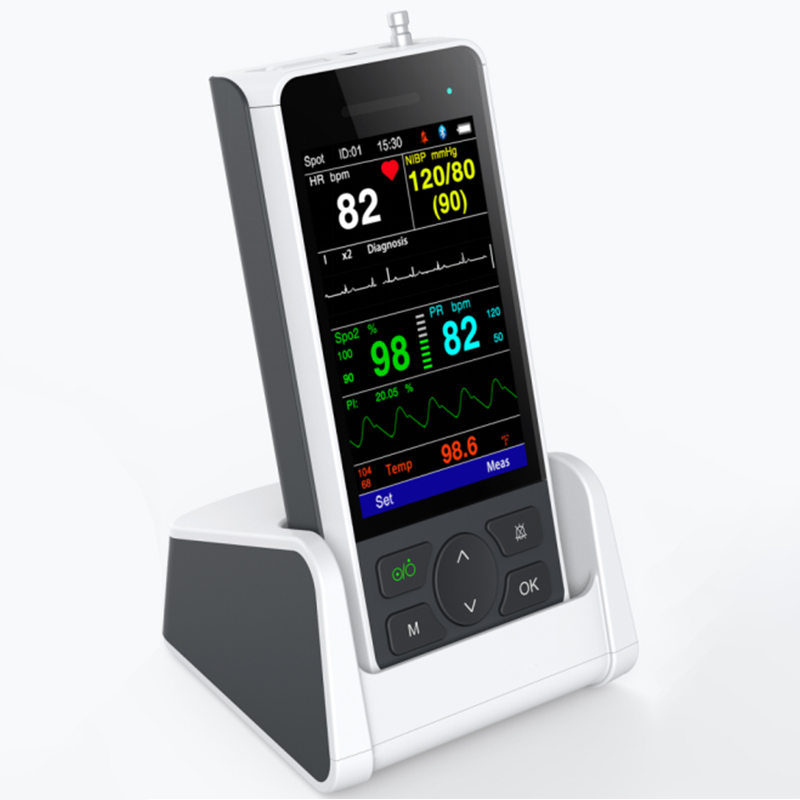
Handheld vital sign monitor
Model:JZWSpet 100
Function:SPO2+NIBP+TEMP+PR
The monitor utilizes various sensors and modules working together to capture different physiological signals. Let's examine each of the four core parameters you mentioned:
Blood Pressure (NIBP): Also known as non-invasive blood pressure, this refers to blood pressure readings taken via a cuff placed on the arm or thigh. It measures systolic pressure (high pressure), diastolic pressure (low pressure), and mean pressure. Measurement methods are highly flexible: manual initiation, automatic continuous monitoring at preset intervals, or rapid screening. Some advanced monitors deliver results in as little as 15 seconds.
Oxygen Saturation (SpO₂): This pulse oximetry value reflects the oxygen content in the blood. It utilizes a small sensor clipped onto a finger, toe, or earlobe, employing specific wavelengths of light to penetrate blood vessels for measurement. This parameter is critical for determining patient hypoxia. Modern monitors employ robust technology to deliver accurate readings even under poor perfusion conditions (e.g., shock, cold extremities causing weak pulses). They can display the perfusion index (PI) to aid in assessing peripheral circulation status.
Body Temperature (TEMP): Measured using a high-precision temperature probe. Monitors typically support dual-channel temperature, enabling simultaneous monitoring of two sites (e.g., oral and axillary, or skin and core) to provide more comprehensive clinical information. According to national standards, the maximum permissible error for temperature measurement in such monitors is only ±0.2°C, ensuring data accuracy.
Pulse Rate (PR): This refers to the pulse rate, or the number of heartbeats per minute. This value is typically measured simultaneously with blood oxygen saturation. Both blood oxygen and pulse rate data can be read at the same time using a single finger sensor, offering great convenience.
Handheld vital sign monitor
Model:JZWSpet 100
Function:SPO2+NIBP+TEMP+PR
The monitor utilizes various sensors and modules working together to capture different physiological signals. Let's examine each of the four core parameters you mentioned:
Blood Pressure (NIBP): Also known as non-invasive blood pressure, this refers to blood pressure readings taken via a cuff placed on the arm or thigh. It measures systolic pressure (high pressure), diastolic pressure (low pressure), and mean pressure. Measurement methods are highly flexible: manual initiation, automatic continuous monitoring at preset intervals, or rapid screening. Some advanced monitors deliver results in as little as 15 seconds.
Oxygen Saturation (SpO₂): This pulse oximetry value reflects the oxygen content in the blood. It utilizes a small sensor clipped onto a finger, toe, or earlobe, employing specific wavelengths of light to penetrate blood vessels for measurement. This parameter is critical for determining patient hypoxia. Modern monitors employ robust technology to deliver accurate readings even under poor perfusion conditions (e.g., shock, cold extremities causing weak pulses). They can display the perfusion index (PI) to aid in assessing peripheral circulation status.
Body Temperature (TEMP): Measured using a high-precision temperature probe. Monitors typically support dual-channel temperature, enabling simultaneous monitoring of two sites (e.g., oral and axillary, or skin and core) to provide more comprehensive clinical information. According to national standards, the maximum permissible error for temperature measurement in such monitors is only ±0.2°C, ensuring data accuracy.
Pulse Rate (PR): This refers to the pulse rate, or the number of heartbeats per minute. This value is typically measured simultaneously with blood oxygen saturation. Both blood oxygen and pulse rate data can be read at the same time using a single finger sensor, offering great convenience.


 Please leave your contact information
 en
en es
es